

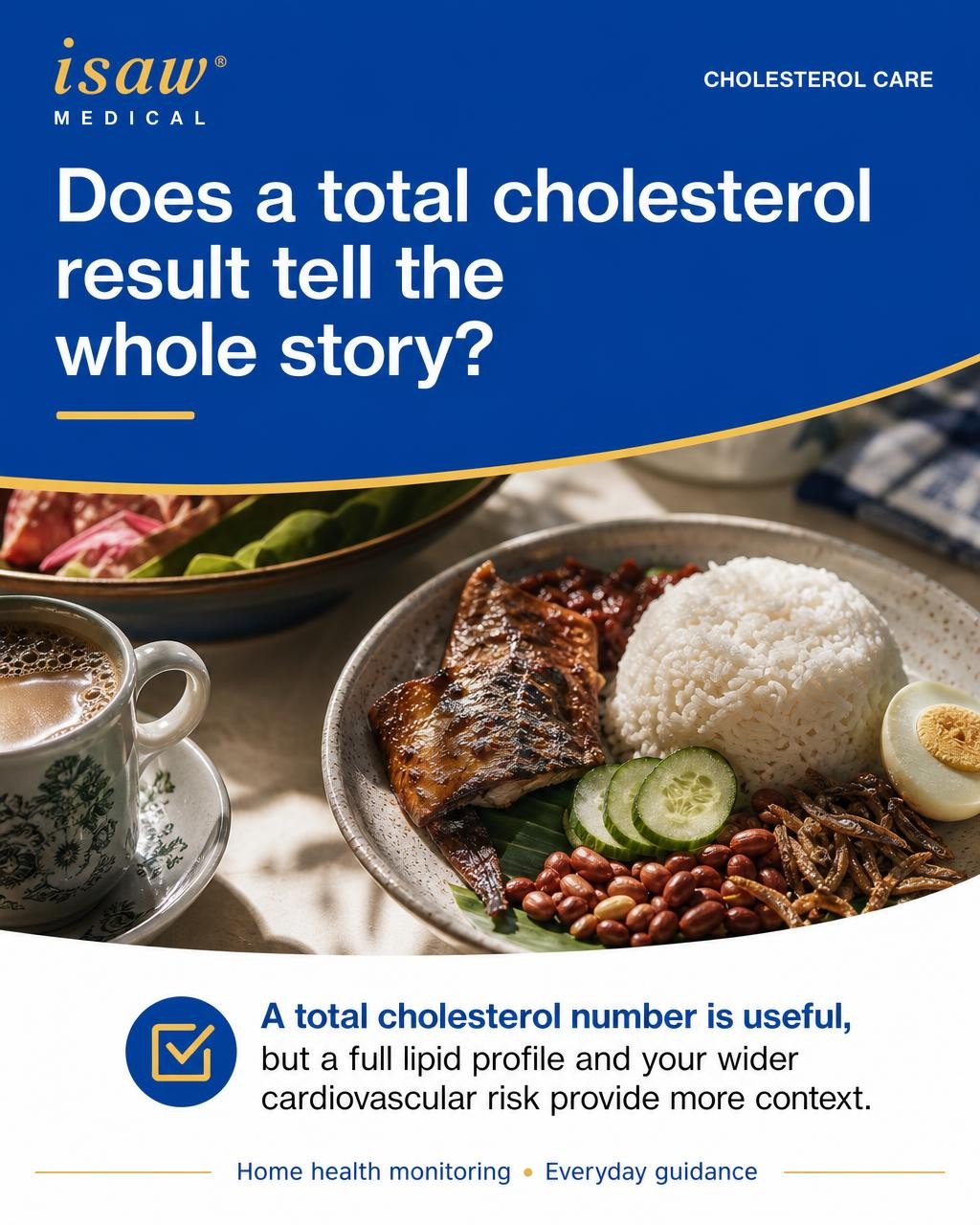
“My total cholesterol is on my home test—does that tell me everything?” It is a common question, especially when you have recorded one number and are unsure what to do with it. The short answer is no: a total cholesterol reading is useful, but it is not the whole picture.
Why a full lipid profile adds context
Dyslipidaemia means an abnormal amount of lipids in the blood. It may involve raised total cholesterol, raised LDL cholesterol, raised triglycerides or low HDL cholesterol. A lipid profile measures total cholesterol, LDL-C, HDL-C and triglycerides, so total cholesterol is only one part of the fuller set of measurements.
LDL-C is the cholesterol type most directly involved in artery plaque build-up, while HDL-C helps remove excess cholesterol from the bloodstream. Dyslipidaemia commonly has no symptoms, so how you feel cannot reliably confirm whether your lipid levels are typical. See the World Health Organization’s Dyslipidaemia fact sheet for the source information behind this overview.
Save this: what one total cholesterol result can and cannot show
- It can show: one measure of cholesterol at a particular time.
- It cannot show on its own: your LDL-C, HDL-C or triglyceride levels.
- It cannot diagnose: dyslipidaemia or explain your overall cardiovascular risk by itself.
- It cannot replace context: results are interpreted alongside factors such as age, blood pressure, diabetes and smoking status, rather than against one universal cut-off.
- It cannot rule out inherited risk: family history matters because familial hypercholesterolaemia is inherited and can cause markedly raised LDL cholesterol.
Home-monitoring: keep the number in perspective
If you use a home test, record the total cholesterol result and date in your notes app, but treat it as a single reading—not a diagnosis and not a full lipid profile. Hb and HbA1c are different blood measures and are not cholesterol measures; they should not be used as substitutes for a total cholesterol result or lipid profile.
When discussing a cholesterol check at a clinic, ask whether LDL-C, HDL-C and triglycerides were included. Not every cholesterol test provides the same information.
Ordinary family choices still matter
At a family meal, cholesterol-aware choices can fit ordinary routines: more vegetables, pulses and wholegrains, with fewer foods high in saturated or trans fats. One meal does not determine a reading, but practical patterns are easier to maintain than all-or-nothing rules.
ISAW Medical combines home health monitoring products with practical guidance and support. Visit ISAW Medical for more health-monitoring guidance.
This article is for general education and does not replace personalised advice from a qualified healthcare professional.