

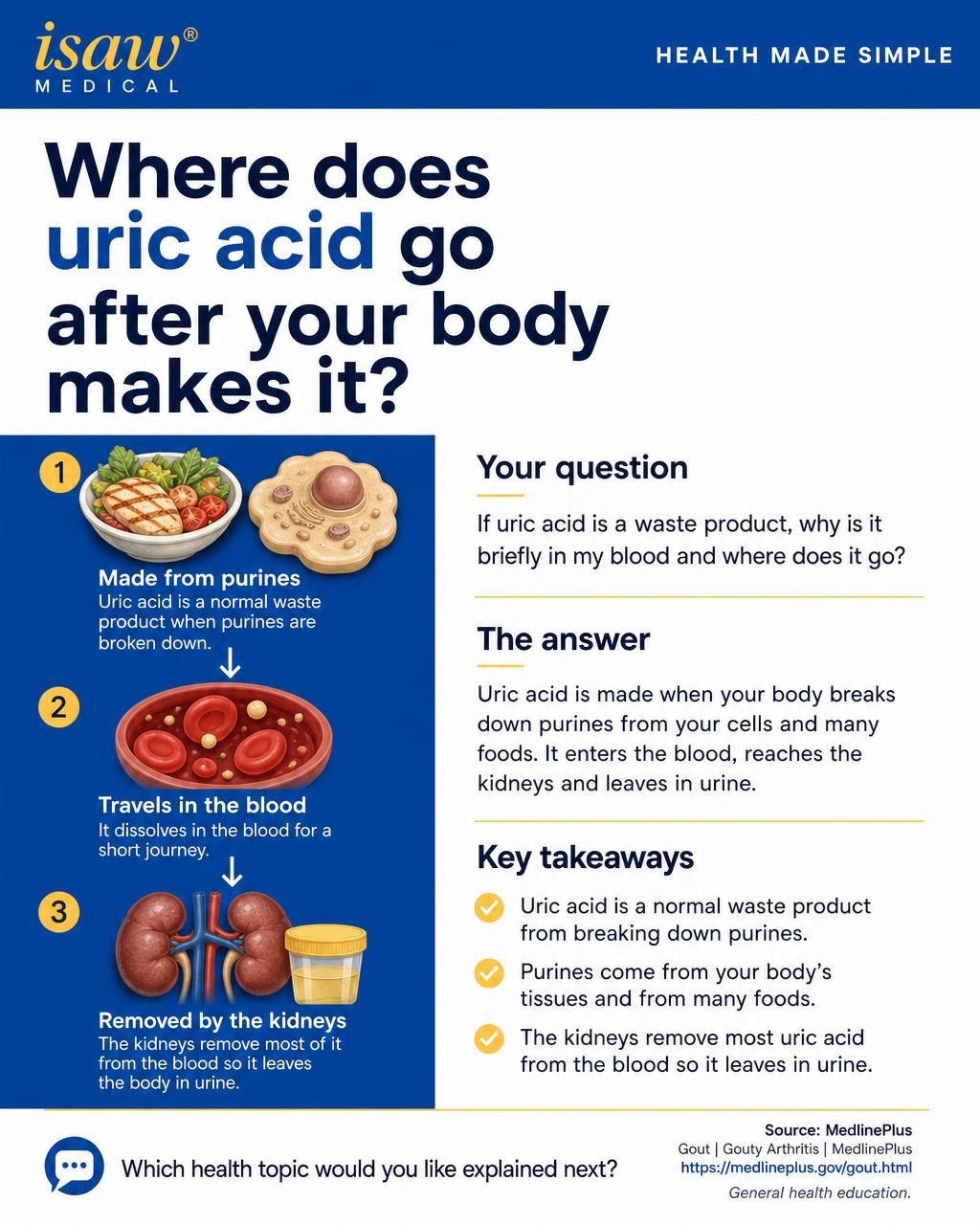
If uric acid is a waste product, why is it briefly in your blood and where does it go? Uric acid dissolves in the blood for a short journey to the kidneys. Most of it then leaves your body in urine.
One everyday example
After your body breaks down old cells or digests food containing purines, it makes uric acid. Purines are natural substances found in your body’s tissues and in many foods.
The uric acid enters the blood, reaches the kidneys and is removed in urine. Think of blood like a short delivery route carrying dissolved uric acid to the kidneys for removal. This is a simplification: your body handles many substances at the same time, not one item at a time.
Three simple points
1. Uric acid is a normal waste product
Your body makes it when it breaks down purines. Its presence in blood is part of the usual route out of the body.
2. Purines come from inside and outside the body
Your own tissues contain purines, and so do many foods. This is why uric acid can be made after normal cell breakdown as well as after digestion.
3. The kidneys do most of the removal
The kidneys filter most uric acid from the blood so it can leave in urine. If too much is made or too little is removed, uric acid can build up.
For more information, see Gout | Gouty Arthritis | MedlinePlus.
The direct answer
Uric acid being in your blood is not, by itself, proof of a health problem. It is normally passing through the blood on its way to the kidneys and out in urine.
ISAW makes everyday health knowledge easier to understand. Learn more at ISAW Medical.
This article is for general education and does not replace personalised advice from a qualified healthcare professional.