

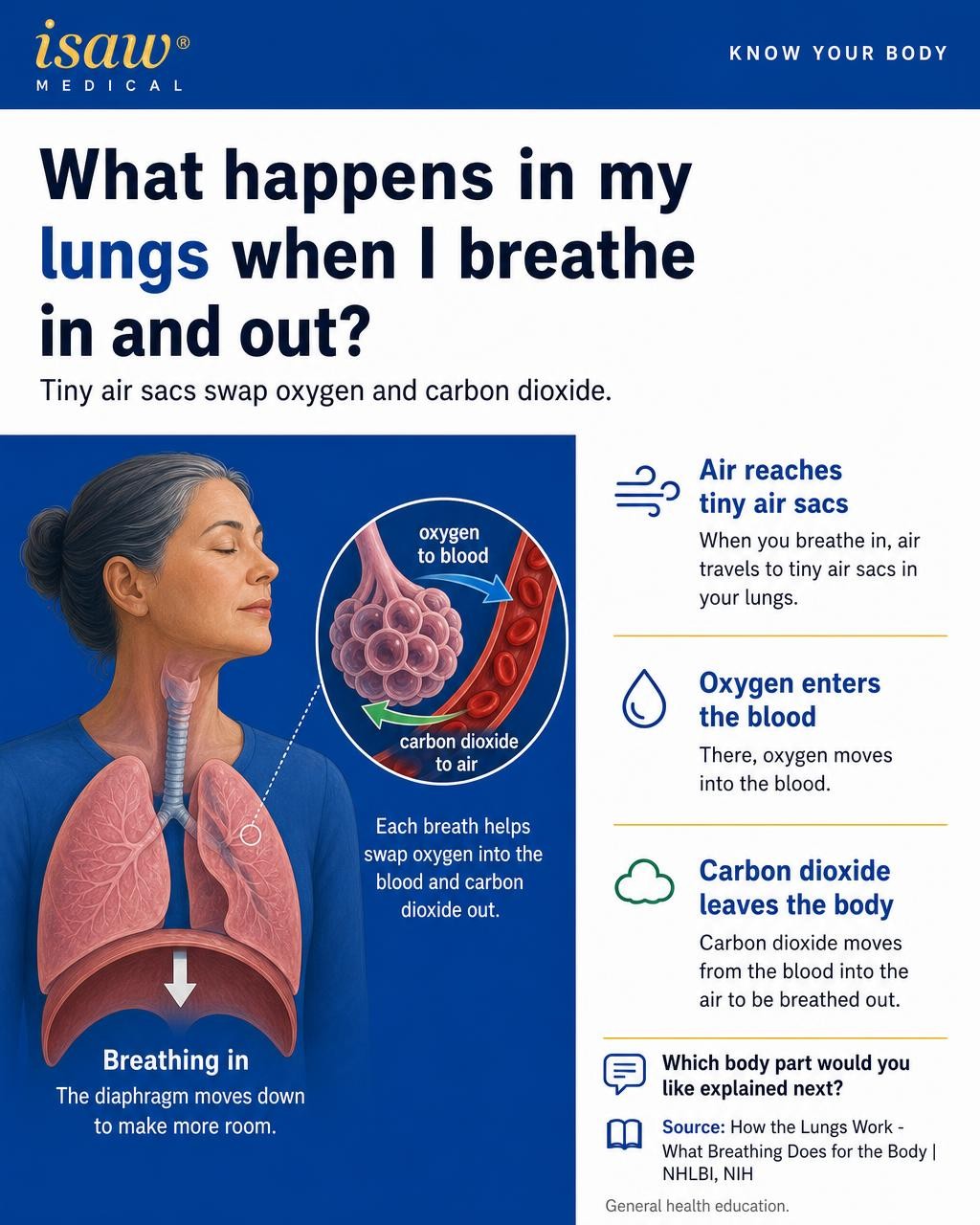
What happens in my lungs when I breathe in and out? Air moves into your lungs, oxygen moves into your blood, and carbon dioxide leaves your blood to be breathed out.
Your lungs bring air to tiny air sacs
When you breathe in, your diaphragm — a large muscle below your lungs — moves down. This gives your lungs more room to expand. Air travels down the windpipe, through smaller air tubes, and reaches tiny air sacs inside the lungs.
Oxygen moves into the blood
The tiny air sacs are a handover point, like a place where two things are exchanged. Oxygen from the air passes into nearby blood vessels. Red blood cells then pick up the oxygen.
The heart helps send this oxygen-rich blood around the body.
Carbon dioxide takes the return journey
Carbon dioxide is a waste gas made when cells release energy. Blood carries it back to the lungs. At the tiny air sacs, carbon dioxide moves from the blood into the air, ready to leave when you breathe out.
- Air reaches tiny air sacs in the lungs.
- Oxygen passes from the air into the blood.
- Carbon dioxide passes from the blood into the air and is breathed out.
Learn more from the National Heart, Lung, and Blood Institute: How the Lungs Work.
ISAW makes everyday health knowledge easier to understand. Visit ISAW Medical.
This article is for general education and does not replace personalised advice from a qualified healthcare professional.