

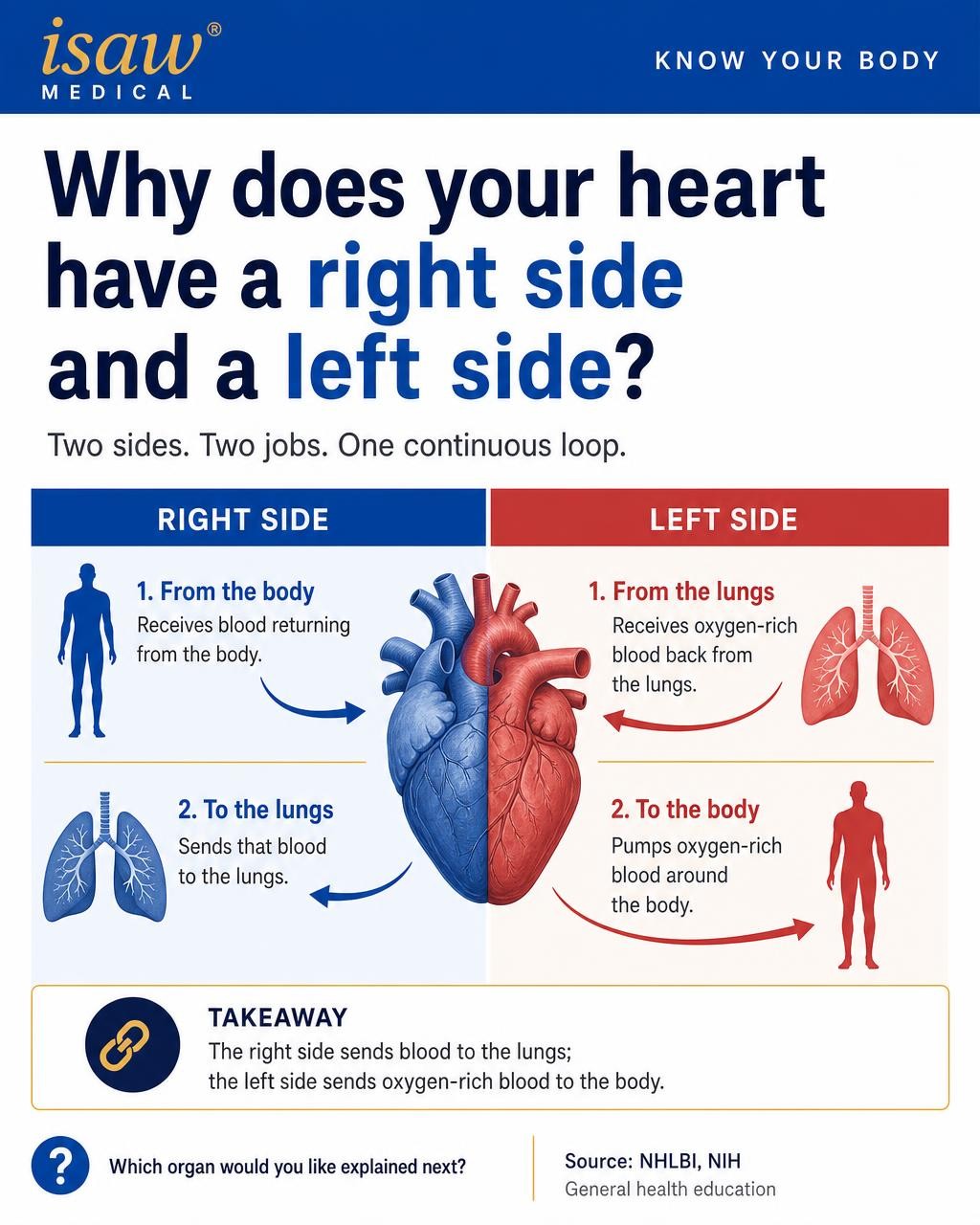
Why does your heart have a right side and a left side? Your heart works as two connected pumps. The right side sends blood to the lungs for oxygen, while the left side sends oxygen-rich blood around the body.
Right side: body to lungs
Blood returning from the body arrives at the right side of the heart with less oxygen. The right side pumps this blood to the lungs.
In the lungs, the blood picks up oxygen. It then travels back to the left side of the heart.
Left side: lungs to body
The left side receives the oxygen-rich blood from the lungs. Its lower pumping chamber, called the left ventricle, pushes this blood out to the rest of the body.
Heart valves act like one-way doors, helping blood keep moving in the correct direction.
Two routes, one continuous loop
You can think of the heart like two linked delivery routes: one goes to the lungs to collect oxygen, and the other sends oxygen-rich blood around the body. This is a simple comparison, as the heart also has detailed chambers and blood vessels.
The right and left sides have different jobs, but they work together in one continuous loop. Learn more in the NHLBI, NIH guide to how blood flows through the heart.
ISAW makes everyday health knowledge easier to understand. Visit ISAW Medical.
This article is for general education and does not replace personalised advice from a qualified healthcare professional.