
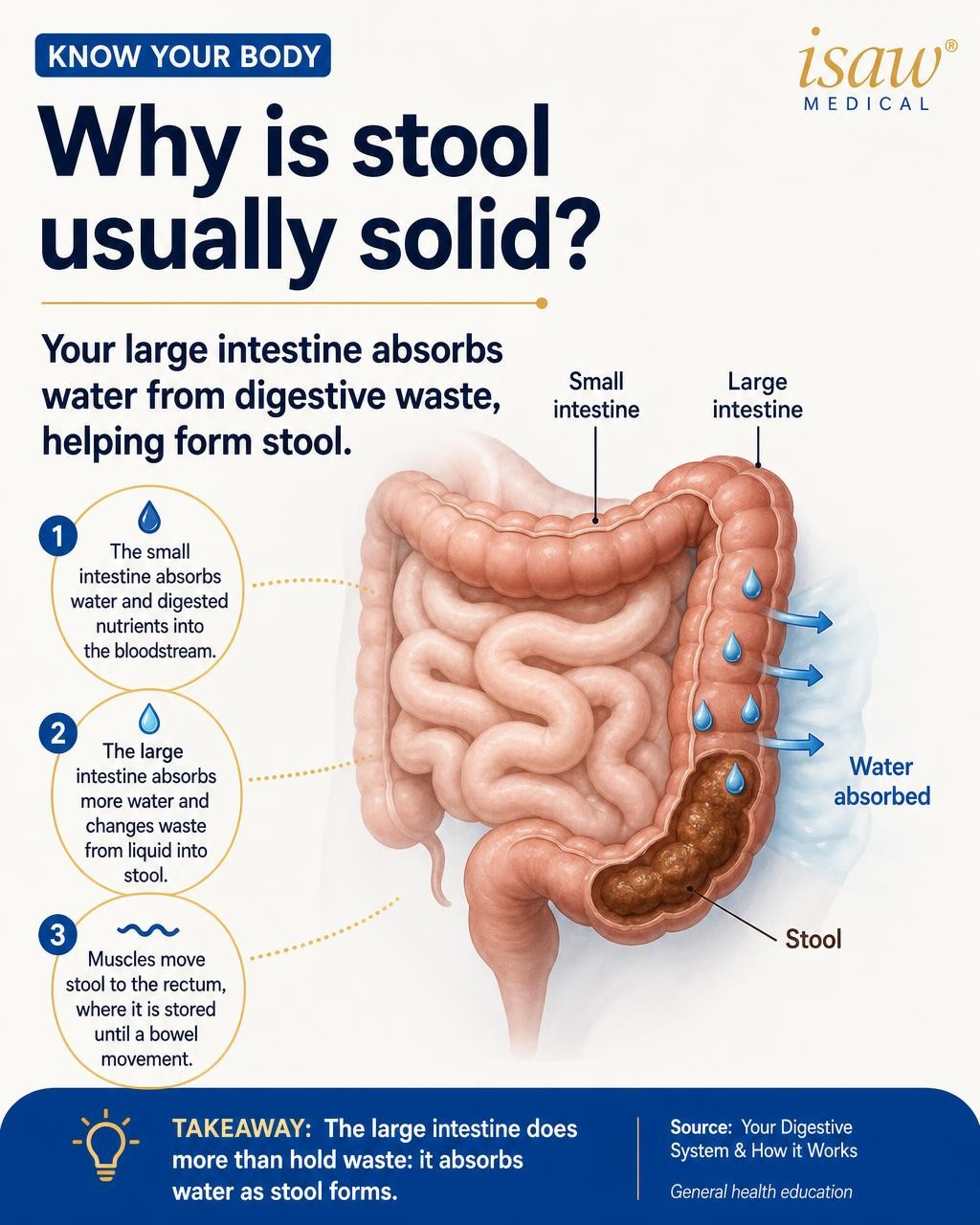
After using the toilet, you may notice that stool is usually formed rather than liquid. The simple answer is that your large intestine absorbs water from digestive waste, helping the remaining waste become stool.
The stool-forming mindmap
Centre: The large intestine helps form stool
Food and drink are broken down as they move through your digestive system. What is left continues on through the intestines.
Branch 1: Water is absorbed
The small intestine absorbs water and digested nutrients into the bloodstream. When the leftovers reach the large intestine, more water is absorbed into the bloodstream.
This is a little like gently draining extra water from a wet mixture. It only describes the water-absorbing part of digestion, not every part of the process.
Branch 2: Waste becomes stool
As water is absorbed in the large intestine, the digestive waste changes from liquid into stool. So, the large intestine does more than hold waste: it helps stool take its usual form.
Branch 3: Muscles move it to the rectum
Wave-like muscle movements move stool into the rectum. The rectum stores it until a bowel movement.
For more on this process, see the National Institute of Diabetes and Digestive and Kidney Diseases guide, Your Digestive System & How it Works.
ISAW Medical makes everyday health knowledge easier to understand.
This article is for general education and does not replace personalised advice from a qualified healthcare professional.